The existing dishwasher has a water connection. The replacement quote adds heat recovery. Can the installer simply connect the new machine to the same supply?
That is a configuration question to answer before comparing the extra option's price. “Heat recovery” describes where thermal energy is captured and used; it does not mean every machine has the same incoming-water requirement. A water line already being present says little about whether its actual conditions match the selected option.
This buying resource follows one specific manufacturer example: MEIKO's Australian M-iClean H information. It separates two recovery paths and uses a conditional feed-water maximum to test two fictional proposals. It does not establish a universal limit for heat-recovery dishwashers, a permitted plumbing arrangement or availability of an exact unit through Atlantic.
Heat recovery: does your inlet still fit?
A heat-recovery option can change the water-supply brief—not just the equipment quote. Before comparing proposals, identify the option and check its inlet requirement.
Two heat sources, not two water supplies
MEIKO’s Australian M-iClean H page describes optional AirConcept exhaust-air recovery and optional wastewater heat recovery. These use different sources of thermal energy to heat incoming water (manufacturer description).
- AirConcept: hot vapour → recovered thermal energy → incoming water warmed.
- Wastewater recovery: warm wastewater → recovered thermal energy → incoming water warmed.
Worked proposal screen: 18 °C versus 45 °C
Fictional proposal: an M-iClean H with AirConcept. The Australian technical page states: “Max. feed water temperature with AirConcept: 20 °C” (technical data). That limit is conditional on AirConcept; it is not a stated limit for wastewater recovery or other units.
Assumed site inlet temperatures; one numerical comparison only. Read across on a phone.
| Site | Comparison | Buying implication |
|---|---|---|
| A: 18 °C | 18 ≤ 20 °C | Passes this inlet-temperature comparison only. Keep the proposal under consideration; other services remain unverified. |
| B: 45 °C | 45 > 20 °C | Fails the quoted AirConcept limit against this assumed inlet. Do not accept that configuration as matching the brief. |
Counterexample: removing AirConcept does not establish that 45 °C is permitted: the alternative’s maximum is unknown here. Request the exact model, options and local feed-water specification before deciding; this is not advice to alter the supply.
This manufacturer example supports comparison within commercial dishwashers, not Atlantic stock or configuration availability. Country versions vary; confirm locally. No site approval, operating-temperature guidance, energy-bill saving or hood exemption is established.
What changes in the buying brief?
In the worked screen, the model family alone is not enough information. The option matters: the published 20°C condition is attached to AirConcept. Write the proposed model, options and source together before comparing the inlet evidence. An unspecified “heat-recovery model” leaves the relevant configuration unresolved.
Site B's 45°C value is an assumed inlet condition, not a temperature measured at a venue. If a real site's evidence exceeds the applicable inlet maximum, the buying brief has a mismatch to resolve. That is different from instructing someone to adjust a valve, combine supplies or alter the plumbing. The responsible supplier and qualified site team need to assess the supported arrangement and all other services.
Site A illustrates the other trap. One favourable comparison does not turn an equipment proposal into an approved installation. Its flow, pressure, treatment, drainage, electrical supply and other applicable requirements have not been established here. Record a resolved inlet-temperature comparison separately from the remaining site assessment.
There is also no bill-saving calculation in this resource. A heat source and a conditional inlet maximum do not supply actual energy consumption, duty, idle periods or tariffs. Similarly, the source example does not decide whether a venue requires extraction. Keep ventilation, installation and any local requirements with the responsible assessment rather than inferring an exemption from an option name.
Keep the example in its scope
MEIKO's Australian technical page notes that product lines and versions can differ by country and directs readers to a local partner. The resource therefore retains the exact named option and the page's narrow condition. It is not a current quote, an assertion of local kit availability or a reason to carry that 20°C limit across every wastewater-recovery option.
Use the existing commercial dishwasher buying guide for actual wash items, arrival groups and staffed handling. The hood-type dishwasher overview covers the broader format. This resource adds a specific option-and-connection check to that enquiry; it does not replace the full machine and wash-area assessment.
About this guide
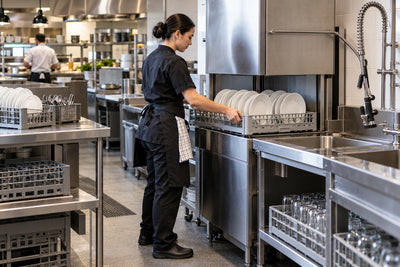
Prepared by Atlantic Equipment for commercial dishwasher buyers comparing heat-recovery options. The Australian MEIKO product and technical pages were accessed on 3 November 2026; the access date is not a declared manufacturer document revision. The specific option descriptions and 20°C condition come from those pages. Both site temperatures and proposals are fictional, and no actual inlet measurement, supplier quote, installation approval, firsthand equipment trial or energy saving is represented. The main image is a generic AI-generated concept, not the named MEIKO model or a customer installation.