The right commercial dishwasher for a busy kitchen is the one matched to your dish volume, your space and your sanitisation needs. A small café is well served by an undercounter unit, a steady mid-size restaurant by a pass-through, and a high-volume venue by a conveyor machine. Get the type and capacity right and the dish pit stops being a bottleneck, turning out clean, sanitised dishes, glassware and utensils with minimal downtime.
📋 What this guide covers
- Why commercial dishwashers outperform domestic units
- The main types and which venues they suit
- The key factors to weigh before you buy
- Maintenance habits that protect your investment
Why a commercial dishwasher matters
A domestic dishwasher cannot keep up with a commercial kitchen. A true commercial machine is built for the demands of continuous service and delivers what a home unit cannot.
- Rapid wash cycles: Often 1 to 3 minutes, for high throughput.
- Serious capacity: It handles racks of dishes, glasses and utensils every hour.
- Proper sanitisation: High-temperature or chemical sanitisation keeps you compliant with hygiene requirements.
- Build quality: Construction suited to heavy daily use.
The right machine cuts manual labour, reduces water and energy waste, holds consistent hygiene standards and improves overall kitchen workflow.
Types of commercial dishwashers and their best uses
Different kitchen sizes, dish volumes and workflows call for different machines. Here is how the main types compare.
| Type | Best for | Approx. capacity* | Key strengths |
|---|---|---|---|
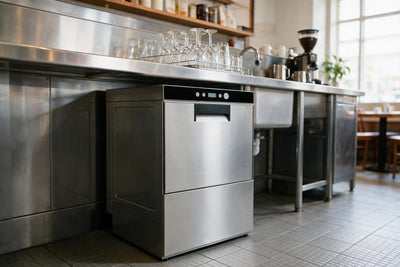
| Undercounter | Small cafés, bars, tight kitchens | 20 to 35 racks/hour | Compact, quick cycles, low footprint |
| Pass-through / hood | Medium restaurants, steady volume | 40 to 60 racks/hour | Ergonomic loading, balanced output |
| Conveyor / flight | Large restaurants, hotels, catering | 100 to 200+ racks/hour | High capacity, continuous flow |
| Glass washer | Bars, pubs, beverage-led venues | Varies | Gentle on glassware, prevents streaks |
*Capacity varies by model, wash settings and load type. Always verify manufacturer specifications.
Key considerations when selecting a dishwasher
Capacity versus workflow demand
Estimate your daily dish load and peak-hour demand. Undersized units create bottlenecks, while oversized units waste energy and space. Size to the busiest period you realistically run.
Space, layout and installation
- Measure floor space and the path racks take in and out, so loading and unloading flow without crossing paths.
- Plan plumbing (drain and water supply), power (often three-phase for high-temp units) and any ventilation the machine needs.
Energy and water efficiency
Modern dishwashers can cut water and electricity use per cycle considerably. Look for low water consumption, efficient heaters and pumps, and eco-wash modes that trim running costs over the life of the machine.
Sanitisation and hygiene compliance
Choose a machine that meets local food-safety standards, whether high-temperature sanitising at 82 to 90 °C or approved chemical sanitisation. This is what makes plates and glassware safe to reuse and keeps you aligned with the FSANZ Food Standards Code.
⚠️ Confirm your power supply early
High-temperature units often need three-phase power and a strong water heater. Check what your site has before you commit to a model, as retrofitting power is a costly surprise late in a fit-out.
Maintenance, durability and service support
Commercial use demands robust construction: stainless steel, strong pumps and easy-access parts. Make sure spare parts are readily available and local technical support exists, so a breakdown does not shut down service for days.
Noise and workflow impact
In open-kitchen or front-of-house settings, noise matters. Choose models with acceptable decibel ratings and good vibration control so the dish pit does not intrude on the dining room.
Pros and cons at a glance
| Factor | Benefit | Potential drawback |
|---|---|---|
| High-speed washing | Fast turnaround | Higher energy and water use per hour |
| High-temp sanitisation | Better hygiene compliance | Needs strong heater or 3-phase power |
| Conveyor systems | Handles large volumes | Needs space and higher upfront cost |
| Undercounter units | Compact, low footprint | Limited capacity, slower throughput |
| Eco / water-efficient | Lower utility bills | Slightly higher purchase cost |
Maintenance that protects your investment
A few consistent habits keep a commercial dishwasher running well and extend its service life.
- Clean daily: Remove food residue and debris, and clear the filters.
- Run sanitisation cycles: After each service day, to meet hygiene standards.
- Schedule periodic servicing: Pumps, heaters, spray arms and seals checked by a certified technician.
- Keep operation logs: Useful for quality control and compliance audits.
- Train staff properly: Correct loading, pre-rinse habits and proper detergent and rinse-aid use.
These practices extend equipment lifespan, prevent breakdowns and keep dish quality and hygiene consistent.
ℹ️ Lifespan depends on upkeep
With proper maintenance, most commercial dishwashers last 7 to 12 years depending on usage intensity. A neglected machine in a high-volume kitchen will fall well short of that.
Compare options across our commercial dishwashers range, look at beverage-focused glasswashers for bars and pubs, and if you are planning a wider fit-out, our guide on choosing the right commercial ice machine covers another key piece of the kitchen.
Frequently Asked Questions
For most small cafés an undercounter dishwasher at roughly 20 to 35 racks per hour is enough, provided daily dish volume is not excessive.
High-temperature sanitising at around 82 to 90 °C cleans effectively and dries faster. Chemical sanitisation can suit low-temp units, but the right choice depends on your local regulations.
Clear debris daily, deep clean weekly, and have a full inspection and maintenance every 3 to 6 months to keep performance and hygiene up.
No. Domestic models are not built for continuous high-volume use and lack the sanitisation, power and durability a commercial kitchen requires.
With proper maintenance, most units last 7 to 12 years, depending on how hard they are worked and how well they are serviced.