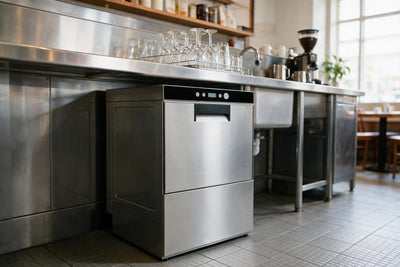
A pass through dishwasher (also called a hood-type dishwasher) is a high-volume commercial machine that cleans a full rack of dishes in roughly 60 to 120 seconds, using a lift-up hood and a bench system that moves racks from the dirty side to the clean side. For busy restaurants, cafés, hotels and catering kitchens, it is one of the fastest, most hygienic ways to keep crockery, glassware and utensils flowing during peak service.
📋 What this guide covers
- How a pass through dishwasher works and why the flow-through layout matters
- The real benefits: speed, ergonomics and high-temperature sanitation
- Key features and machine types to compare before you buy
- How to match a unit to your wash volume, layout and utilities
- Daily best practices and answers to common questions
What is a pass through dishwasher?
A pass through dishwasher is built around a vertical lift hood. Instead of loading dishes through a front door, racks slide in and out along a bench, creating a clean flow from the soiled inlet side to the clean outlet side. That single design choice is what makes these machines so well suited to high-volume venues.
How it works
- Load: place the soiled rack on the inlet bench.
- Slide in: push the rack into the wash chamber.
- Start: pull down the hood and the cycle begins automatically.
- Unload: when the cycle finishes, lift the hood and slide the rack out to the clean bench.
This workflow reduces bending, speeds up turnover and supports a tidier, better-organised kitchen.
Benefits of a pass through dishwasher
- High-speed cleaning: a full rack washes in just 60 to 120 seconds per cycle.
- Ergonomic workflow: staff slide racks across the bench rather than bending to a front-loading door.
- Superior hygiene: high-temperature rinsing supports sanitation compliance in commercial kitchens.
- Water and energy efficiency: modern systems use less water per cycle than older commercial dishwashers.
- Built for volume: ideal for restaurants, hotels, catering operations, production kitchens, schools and hospitals.
ℹ️ Why rinse temperature matters
High-temperature rinsing (typically around 82°C at the final rinse for hot-water sanitising machines) is what delivers reliable sanitation. A booster heater holds that temperature even when incoming supply varies, so every rack comes out to the same standard.
Key features to look for
| Feature | Why it matters |
|---|---|
| Cycle speed | Faster cycles mean quicker turnover during peak hours. |
| Water consumption | Lower usage per cycle reduces ongoing running costs. |
| Booster heater | Ensures hot rinse temperatures for proper sanitation. |
| Drain pump | Allows flexible installation above or below drain level. |
| Rinse pump | Provides consistent rinse pressure regardless of supply variations. |
| Double-skin construction | Reduces heat loss and running noise. |
| Automatic hood start | Improves workflow speed and hygiene. |
| Pre-rinse compatibility | Enhances cleaning efficiency for heavily soiled loads. |
Types of pass through dishwashers
- Standard pass through units: reliable cleaning for everyday commercial use.
- High-temperature machines: suited to kitchens that prioritise heat-based sanitation without chemical sanitisers.
- Energy-recovery models: capture steam to preheat incoming water, cutting power consumption.
- Corner configuration models: fit into corner benching layouts to make better use of space.
Is a pass through dishwasher right for your kitchen?
A pass through dishwasher earns its place if your kitchen:
- Washes more than 20 racks per hour
- Has a linear or corner bench layout
- Wants an ergonomic, fast washing workflow
- Requires consistent sanitation results
- Needs to clear bottlenecks during peak service
If your volumes are lower, an undercounter machine may suit you better. Our guide on how to choose the right commercial dishwasher for busy kitchens walks through the trade-offs in more detail.
How to choose the best pass through dishwasher
1. Match the machine to your wash volume
Higher volumes call for faster cycles and larger wash pump capacity. Size for your busiest hour, not your daily average.
2. Check utility requirements
- Three-phase power
- Hot or cold water inlet
- Booster heater compatibility
3. Look for energy efficiency
Energy-recovery and heat-pump systems cut long-term running costs by reusing heat that would otherwise be lost.
4. Assess your kitchen layout
Choose between straight-line benching and a corner configuration based on the space and the path from soiled to clean.
5. Evaluate durability and rinse quality
Stainless steel construction and heavy-duty components keep a machine reliable under load, while a stable rinse pump maintains consistent pressure and hygiene compliance.
6. Plan for maintenance
Favour machines with self-cleaning cycles, removable wash arms and smooth internal chambers that are quick to clean down at the end of service.
🔧 Pro tip from our team
Make sure your machine supports compatible inlet and outlet benching, and invest in professional installation to avoid drainage problems. Training staff on auto-start and correct rack alignment protects both your throughput and your results.
Best practices for daily use
- Pre-rinse to remove food debris before loading
- Load racks properly so spray reaches every surface
- Change the wash water when it is visibly dirty
- Clean the wash arms daily
- Use commercial-grade detergent and rinse aid
- Schedule periodic descaling in hard-water areas
⚠️ Don't skip steam management
Many machines include built-in steam management, but extraction and ventilation requirements vary by site. Always check your local regulations and council requirements before installation.
Pairing the right machine with the right glassware handling matters too. If glass polishing and spotting are a priority, compare a dedicated unit from our commercial glass washers range alongside your pass through choice.
Frequently Asked Questions
Most cycles run between 60 and 120 seconds, depending on the model and the cycle selected.
Many machines include built-in steam management, but extraction requirements vary by site. Always check local regulations before installing.
Some heavy-duty units can handle GN pans and light cookware, but pass through machines are primarily designed for dishware, glassware and utensils. For heavy cookware, consider a dedicated utensil or pot washer.
Typically between 2 and 3 litres per cycle, depending on the model. Energy-recovery units can use less while also reducing power consumption.
Both straight-line and corner configurations work well. The right choice depends on your available space and the path your team needs from the soiled side to the clean side.