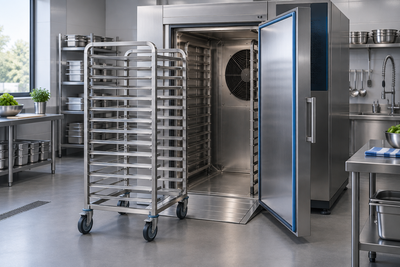
On Wednesday the dry store looks half empty. On delivery morning the flour tubs, oil containers and spare stock all need a home at once. Buying shelving from Wednesday’s photograph can leave Friday’s load without an agreed place.
Start with a shelf-by-shelf stock worksheet. It tells the supplier what each level must hold, including containers, and where concentrated loads sit. That is a useful buying brief. It is not a calculation of the shelf’s structural capacity.
The worked example below counts a delivery-day load, catches an average-weight mistake and separates the information you can measure from the rating only the exact shelving documentation can establish.
Count the heaviest normal day
Choose the stock position you need the storage system to accommodate: for example, immediately after a normal delivery before existing stock has been used. State that moment on the worksheet. If a seasonal order is materially different, give it another scenario rather than quietly combining incompatible quantities.
List the actual items, number of containers and filled mass of each. Use kilograms for mass and millimetres for footprint dimensions. Note whether the figure is weighed, read from packaging or still unknown. The net contents printed on a bag are not automatically the gross mass the shelf supports.
A filled container measurement should say whether it includes the tub, lid, scoop and product. Use an appropriate weighing method; do not add trial weights to an existing shelf to discover when it bends. Unknown stock mass remains an open row until measured or otherwise established.
Worked example: 103 kg of stock, not “about 25 kg a shelf”
Hypothetical stock plan, not a recommended loading arrangement. Imagine a four-level dry-store proposal. The levels below are simply labelled A–D; their order does not prescribe which items belong high or low. The supplier must assess the complete arrangement, retrieval task and stability requirements.
| Level | Proposed contents | Filled/container-inclusive mass | Level subtotal |
|---|---|---|---|
| A | 6 ingredient tubs | 4.0 kg each | 6 × 4.0 = 24.0 kg |
| B | 4 ingredient tubs plus 2 reserve jars | 7.5 kg per tub; 1.5 kg per jar | 30.0 + 3.0 = 33.0 kg |
| C | 3 filled containers plus 1 utensil box | 6.0 kg per container; 4.0 kg box | 18.0 + 4.0 = 22.0 kg |
| D | 2 ingredient cartons plus spare lidded containers | 9.0 kg per carton; 6.0 kg combined spares | 18.0 + 6.0 = 24.0 kg |
| Stock total | All four proposed levels | Packaging/containers included as stated | 103.0 kg |
Scroll the table sideways to see every column.
The stock total is 24 + 33 + 22 + 24 = 103 kg. Dividing by four gives an average of 25.75 kg per level. That average hides Level B’s 33 kg and tells you nothing about where its tubs are placed.
Now imagine a quote with a whole-unit figure but no individual shelf limits. You cannot approve Level B by dividing that unit number by four. Conversely, multiplying an individual shelf figure by four does not establish the complete unit rating. Request both applicable limits and their loading conditions.
The 103 kg here is a stock subtotal. It is not a measured complete system mass, a floor-loading calculation or a pass against any manufacturer rating. Ask the supplier how its definition treats accessories, shelving self-weight and any other relevant components.
Containers can change the answer
For one hypothetical tub on Level A, suppose the ingredients weigh 3.4 kg and the tub, lid and scoop weigh 0.6 kg. The filled unit weighs 4.0 kg. Six contain 20.4 kg of ingredients but impose 24.0 kg of container-inclusive stock mass. Using only ingredient mass misses 3.6 kg across that row.
Keep the measurement method consistent. If a carton is weighed complete, do not add its packaging again. If only net contents are known, record packaging as unresolved rather than assuming it weighs nothing. The worksheet’s “includes” note prevents both omissions and double counting.
When a different supplier changes packaging or a bulk ingredient moves into a larger tub, revisit both the mass and footprint. A larger container can alter access even if the mass stays the same.
Read the rating’s conditions before comparing numbers
A useful quote identifies the shelving family, exact shelf dimensions, number of levels, support arrangement and whether the unit is stationary or mobile. The manufacturer’s documentation should explain the applicable shelf and complete-unit ratings and the conditions attached to them.
Metro’s official MetroMax i stationary shelving information, for example, distinguishes whole-unit capacity from shelf capacity and describes shelf-length-dependent ratings. Cambro’s Camshelving Premium starter manual separately distinguishes standard shelves, mobile units and corner-connected arrangements. These international examples show why one large number cannot represent every configuration.
They are not ratings for the hypothetical stock plan or evidence that either system is the right product for this venue. Ask for current documentation covering the exact Australian supply. Do not apply a stationary rating after adding castors, or extend a short-shelf figure to a longer shelf without the maker’s confirmation.
| Question | Evidence to keep |
|---|---|
| Is the figure per shelf or per unit? | Applicable manufacturer rating and definition |
| Which dimensions and supports does it cover? | Exact model/configuration drawing |
| What load distribution is required? | Documented conditions and supplier assessment of your stock plan |
| Do castors or corner connections change it? | Rating for the quoted version and accessories |
| Does the environment suit the system? | Confirmation for dry store, wet area or coolroom as applicable |
| What installation/stability requirements apply? | Manufacturer instructions and appropriate site assessment |
Scroll the table sideways to see every column.
Weight totals do not describe concentrated loading
Two layouts can have the same 33 kg subtotal on Level B. One spreads the containers across the available surface; another groups them beside one upright or places jars on top of a small stack. The worksheet should preserve that difference with a top-view sketch and item positions.
Do not calculate an “equivalent evenly distributed load” by averaging a heavy item across the whole shelf area. That would replace the actual load pattern with a more convenient one. Ask the supplier how the proposed concentrated items relate to the manufacturer’s permitted loading conditions.
Measure the container footprints with lids, handles and projections included. Show the usable shelf surface, required access and any dividers or accessories. Avoid treating a shelf’s nominal width as unobstructed internal space. Record how staff retrieve a tub without shifting every item in front of it.
The handling task matters alongside weight. A physically possible arrangement may be inconvenient to replenish or retrieve. Ask for an arrangement that addresses the intended users and stock rotation, rather than accepting a packed diagram that can only be unloaded from the front row backwards.
Build a brief that survives the next stock change
For your own supplier brief, record actual stock weights, shelf allocation, complete loaded configuration and manufacturer-supported loading evidence. Replace the fictional inputs with actual evidence and leave unresolved decisions visible.
- Record the scenario: delivery timing, environment and intended stock maximum.
- Measure each filled item: identify what its mass includes and its footprint.
- Assign each level: calculate item subtotals and preserve unknowns.
- Draw the arrangement: flag stacks, concentrated items and access needs.
- Obtain the answer: ask the supplier to match the plan to documented ratings and configuration requirements.
“Please assess this delivery-day stock plan against the exact shelving configuration quoted. State the applicable per-shelf and whole-unit ratings, their load-distribution conditions and any changes caused by dimensions, castors or connections. Identify installation and stock-layout assumptions still requiring confirmation.”
Compare Atlantic’s shelving and racking against the same completed brief. Reopen the assessment when quantities, containers, shelf positions or the shelving configuration change.
Sources and example boundaries
- MetroMax i stationary shelving manufacturer information: distinct unit/shelf capacities and length-dependent ratings.
- Cambro Camshelving Premium starter manual: configuration-dependent shelf, mobile-unit and corner-connection guidance.
Checked 18 October 2026. International manufacturer examples explain rating definitions, not Australian availability or a specified product recommendation. Every stock mass and quantity here is hypothetical; no load test, structural assessment or installation compliance is claimed.
About this guide
Prepared by Atlantic Equipment. This worksheet-led guide helps kitchen buyers document delivery-day stock before comparing shelving. Its worked totals distinguish ingredient mass from container-inclusive stock and preserve each level’s actual load pattern. The arithmetic describes the proposed contents; it does not establish the shelving’s capacity or replace manufacturer guidance and site assessment.