


Patty Makers
Looking to streamline burger production in your commercial kitchen? Our commercial-grade Patty Makers are engineered for precision and efficiency, allowing chefs to produce uniform patties with speed and consistency. Whether you run a high-traffic burger joint or a catering facility, investing in a professional Patty Maker saves labor and ensures portion control every time.
No products found
Use fewer filters or remove all
WE’RE HERE TO ANSWER
Patty Makers FAQs
What's the difference between manual and automatic patty makers?
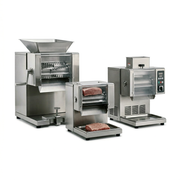
Manual patty makers rely on hand-operated levers and are ideal for low-volume operations, offering affordability and control. Automatic patty makers, often electric or pneumatic, can produce hundreds to thousands of patties per hour, ideal for high-volume production. They allow for programmable features like thickness, speed, and even conveyor integration for seamless assembly lines.
Do commercial patty makers require special electrical or air connections?
Yes. Basic models may only need standard 10A single-phase power, while high-output automatic units may require 15A or even 3-phase power. Pneumatic patty makers require a compressed air line (typically 90–110 PSI). Always consult the data plate and manufacturer electrical requirements to ensure compatibility with your kitchen setup.
How do I properly clean and maintain a patty maker?
First, unplug or disconnect the machine before disassembling. Remove the hopper, mold plate, and meat trays—most are dishwasher-safe. Clean all surfaces with warm, soapy water. Lubricate moving parts using food-grade grease per manufacturer guidelines. Monthly blade inspections and alignment checks are also crucial to maintain performance and minimize breakdowns.
What is the hourly output capacity of a commercial patty maker?
Hourly output varies by model. Manual units typically produce 200–400 patties/hour depending on operator speed. Electric automatic models can generate 1,200–2,100 patties/hour with adjustable thickness and diameter settings. Hopper size also affects productivity—larger hoppers allow continuous operation with fewer refills.
Why use a commercial patty maker instead of hand-forming patties?
A patty maker ensures consistent size, weight, and shape, which improves cooking uniformity and portion control. This reduces food waste, shortens cooking time, and enables faster order fulfillment. Hand-forming is labor-intensive and inconsistent, leading to inefficiency and variable product quality. A patty maker delivers faster ROI through streamlined operations.