The right commercial fridge is the one matched to your space, your daily stock volume and how hot your kitchen runs. Commercial units are built for the demands of restaurants, cafés, bars, hotels and catering kitchens, where frequent door openings, hot conditions and high storage loads would overwhelm a domestic fridge. Most hold food between 1°C and 4°C, and the choice usually comes down to fridge type (upright, under-bench, display or worktop), ventilation, and energy efficiency.
📋 What this guide covers
- Why commercial fridges differ from domestic units
- The main fridge types and where each fits
- Key features to compare before you buy
- Placement tips that protect performance
- Answers to common questions on temperature and lifespan
What are commercial fridges?
Commercial fridges are heavy-duty refrigeration units designed to hold safe temperatures despite frequent door openings, hot kitchen conditions and high storage demand. They deliver reliable cooling, stronger airflow systems, food-safe capacity and tougher construction for daily use.
That durability is why they sit at the centre of almost every professional kitchen workflow.
Why commercial fridges matter
- Consistent temperature control: they hold stable internal temperatures even during peak service, protecting food quality and hygiene.
- Improved food safety: stronger compressors and optimised airflow keep ingredients in safe temperature zones.
- Heavy-duty durability: built for continuous operation in demanding, high-traffic environments.
- Better organisation: adjustable shelving, deep compartments and Gastronorm (GN) compatibility improve productivity.
- Energy efficiency: better insulation, efficient compressors and smarter cooling cut electricity costs.
Types of commercial fridges
Choosing well starts with understanding the formats available.
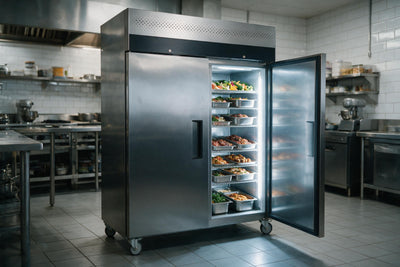
Upright (vertical) fridges
- Large storage capacity
- Easy visibility and access
- Common in restaurants and hotels
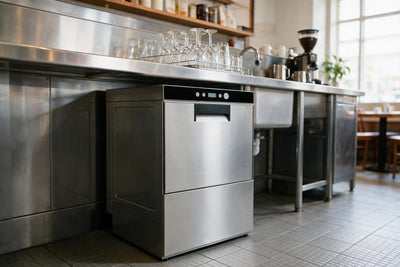
Under-bench fridges
- Fit neatly under preparation counters
- Ideal for compact kitchens or prep stations
- Keep frequently used items close at hand
Countertop display fridges
- Suit beverages, desserts and ready-to-grab items
- Often used in cafés or front-of-house areas
Worktop fridges
- Double as a prep surface and refrigerated storage
- Popular in sandwich bars, pizza shops and cafés
Glass door fridges
- Excellent visibility for staff and customers
- Ideal for retail or beverage display
Two-door and three-door fridges
- Larger capacity for high-volume kitchens
- Efficient for large restaurants, catering and hotels
Key features to compare
| Feature | What to look for |
|---|---|
| Temperature and control | Clear digital controls for precise regulation |
| Construction | Stainless steel interior and exterior for hygiene and durability |
| Ventilation | Front-vented units suit tight spaces; rear-vented need more clearance |
| Refrigeration system | Fan-forced cooling is more consistent; static cooling is more energy-efficient |
| Energy efficiency | Efficient compressors and quality insulation to lower running costs |
| Storage layout | Adjustable shelves or GN tray compatibility for flexible workflow |
| Door type | Solid, glass or self-closing, chosen to match your operation |
ℹ️ Fan-forced or static cooling?
Fan-forced (dynamic) systems circulate cold air for even, fast-recovering temperatures, which suits busy kitchens with constant door traffic. Static cooling is quieter and can use less energy, but temperatures vary more by shelf. For most commercial prep and storage, fan-forced is the safer default.
Placement tips for better performance
- Avoid heat sources: keep fridges away from ovens, fryers and dishwashers to prevent temperature swings.
- Maintain ventilation space: allow enough clearance for airflow, especially for rear-vented units.
- Keep doors closed: train staff to minimise door-open time to preserve stability.
- Clean coils regularly: dirty condenser coils make the fridge work harder and use more power.
- Organise with FIFO: use First In, First Out and clear labelling to cut waste and improve workflow.
⚠️ Leave room to breathe
A rear-vented fridge pushed hard against a wall cannot shed heat properly, so the compressor runs longer, temperatures drift and energy bills climb. Check the manufacturer clearance before you build it into a tight run, and never block the vents with stock or packaging.
How to choose the best fridge for your kitchen
- Kitchen space and layout: measure carefully, including depth and ventilation needs.
- Storage needs: consider how much daily or weekly stock you keep chilled.
- Kitchen temperature: hot kitchens need more powerful compressors for consistent cooling.
- Energy consumption: compare ratings for long-term savings.
- Brand reputation: choose reliable commercial brands known for performance and durability.
To browse units by format, see our under-bench fridges, upright storage fridges, upright display fridges and drinks display fridges. For the full range, view all commercial fridges. If you also store frozen stock, our commercial freezers cover chest, upright and under-bench options.
Frequently Asked Questions
Most commercial fridges hold between 1°C and 4°C to keep food safe. Check the unit with an independent thermometer rather than relying only on the display.
With proper maintenance they typically last between 7 and 12 years. Regular coil cleaning and prompt seal replacement extend that lifespan.
Yes. Stronger compressors produce more noise but deliver superior cooling performance, which matters in a busy kitchen with constant door openings.
A glass door gives better visibility for staff or customers, while a solid door offers better insulation and energy efficiency. Choose based on whether display or running cost matters more.
Front-vented units suit tight spaces and built-in installations because they exhaust from the front. Rear-vented units need clearance behind for airflow, so they work best in open positions.