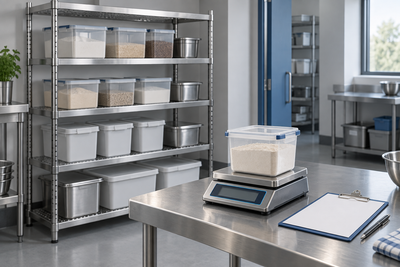
Concept illustration of a commercial kitchen. This is not a measured installation, the worked production periods or evidence that the pictured equipment is energy-efficient.
The oven used less electricity this week. It also produced fewer trays. Before calling that an efficiency improvement—or using it to justify a replacement—check what work the meter reading represents.
To reduce commercial kitchen energy costs, build a baseline that connects consumption, operating conditions and useful output. A lower total can reflect less trading, a shorter operating window, a different product or an incomplete measurement boundary. The bill is a starting point for investigation.
The worked example below compares three fictional production periods. It shows how total energy and energy per output can tell different stories, then turns the result into a practical measurement and equipment brief. No appliance performance or savings forecast is claimed.
Decide what the reading includes
Write down the measurement boundary first: the whole premises, a circuit, an appliance or a defined process. Identify the meter, units, start and finish times and relevant equipment included or excluded. A premises bill cannot identify an individual oven’s consumption without further evidence.
The Australian Government’s energy-audit guidance links a baseline to business activities and output, and highlights daily, monthly and seasonal variation. Use your bills and retailer data for the wider operating picture, with an appropriate assessment where you need more detail.
For a specific equipment question, agree the measurement method with a suitable energy professional or equipment provider. Do not open switchboards, alter wiring or attach unsuitable monitoring equipment to obtain a reading. A proposed meter must suit the installation and the question being investigated.
Keep electrical energy in kWh distinct from an electrical input rating in kW. A nameplate power figure is not a record of how much energy an appliance consumed during a service. Avoid treating rated input multiplied by opening hours as measured use.
Worked comparison: less energy, more per tray
All readings, quantities and prices here are invented. Assume an agreed appliance measurement boundary includes the whole nominated operating period. “Output unit” means one agreed tray of a nominated product accepted under the venue’s separate quality and food-safety process. It is not a tray-count guarantee for any oven.
The example rate is AUD $0.32 per kWh excluding GST, used only for the listed consumption calculation. Fixed charges, demand charges, other fuels, water, labour and every other cost are excluded.
| Fictional period | Recorded electricity | Accepted output units | kWh per unit | Listed energy cost, AUD ex GST |
|---|---|---|---|---|
| A — baseline period | 36 kWh | 30 trays | 36 ÷ 30 = 1.20 | 36 × $0.32 = $11.52 |
| B — lower-output period | 28 kWh | 20 trays | 28 ÷ 20 = 1.40 | 28 × $0.32 = $8.96 |
| C — candidate comparison | 33 kWh | 30 trays | 33 ÷ 30 = 1.10 | 33 × $0.32 = $10.56 |
Scroll the table sideways to see every column.
B uses eight fewer kWh and its listed energy cost is $2.56 lower than A. Yet its arithmetic energy intensity is 1.40 rather than 1.20 kWh per tray: less energy overall, more energy per recorded output. A lower total alone does not establish a more efficient machine or process.
C matches A’s output count and uses three fewer kWh, giving a listed $0.96 difference for the period. That is a more useful comparison to investigate, but matching the count is only one condition. Product, starting conditions, operating window, quality, rework and the measurement boundary still need checking.
Do not turn these invented figures into an annual saving. You would first need representative evidence that the difference recurs at your actual duty and tariffs. No tax-credit treatment, finance result or equipment payback is calculated.
Keep the work equivalent before ranking proposals
A tray is a convenient denominator only if it describes comparable work. Record the product, loaded quantity, container arrangement and required accepted outcome. Counting rejected or reworked output as useful production can make a poor process look attractive.
| Comparison check | What to record | Why the result may change |
|---|---|---|
| Product and load | Same nominated task, quantities and container arrangement | Equal tray counts can contain different work |
| Operating period | Start-up, active production, idle intervals and any included close-down | A shorter reading may omit part of the task |
| Conditions | Relevant starting and site conditions, settings and supporting systems | The surrounding duty may differ |
| Accepted outcome | Agreed quality and food-process acceptance; rework separately | Unacceptable output is not a useful saving |
| Measurement | Meter, units, boundary, timestamps and completeness | A changed boundary can hide consumption |
| Cost basis | Actual applicable energy charges and explicit exclusions | Usage-only arithmetic is not the complete bill |
Scroll the table sideways to see every column.
Ask the supplier to show its test conditions alongside a consumption figure. If those conditions differ from the venue’s job, identify the difference and the evidence needed to compare it. Keep an estimate labelled as an estimate.
Investigate operating changes as controlled proposals
Once the baseline is clear, look for avoidable operation: a station started before it is needed, a long empty interval, repeated rework or a task split across equipment unnecessarily. Record what you observed and propose a specific change for assessment.
Do not adopt a universal switch-off schedule from this article. Cooking start-up, product holding, refrigeration, cleaning programs and required ventilation have different operating requirements. Have the responsible people assess the selected equipment’s instructions and the venue’s food-safety and services requirements before changing controls or timings.
For example, “test whether this nominated oven can start later and still complete the agreed workload” is a reviewable proposal. “Turn everything off between services” is not a site-specific operating plan. State the readiness test and who can approve the change.
If you suspect a fault, retain the observations for a qualified service assessment. A higher reading does not establish a dirty component, failed control or repair method. Use the maintenance task register to distinguish permitted operator care from specialist work.
Check whether a saving survives outside the appliance
A proposed replacement can change other loads or operating tasks. Identify relevant hot-water supply, ventilation, cooling, treatment and supporting equipment when defining the system being compared. Avoid claiming a whole-kitchen saving from a measurement that covers only one part.
energy.gov.au’s metering and monitoring guide discusses baseline data, meter capability and measurement resolution. An appropriate assessment can help decide which information your comparison needs. This article does not prescribe a meter installation or an engineering method.
Retain the complete installed price and ownership terms separately from the energy record. Even a demonstrated consumption difference does not answer delivery, site-work, maintenance, reliability or funding questions. Bring those into the purchasing comparison rather than treating one favourable measurement as the whole decision.
Repeat the check and keep exceptions visible
Agree a representative set of operating periods with the people assessing the change. Record unusual production, missing data, interruptions and relevant changes to conditions. Do not silently delete an inconvenient period or choose only a quiet day.
After an agreed change, measure the defined task again using the consistent method. Retain the before-and-after evidence and any reason the comparison is incomplete. A continuing record is more useful than an isolated favourable screenshot.
For the fictional C period, the next action is to verify equivalence and repeatability, not to order a machine on a promised $0.96 saving. For B, investigate what changed in output and operation before diagnosing worse equipment efficiency from the arithmetic intensity alone.
Prepare the energy-and-output comparison
For your own supplier brief, record period energy, useful accepted output, measurement conditions, usage-only cost and unresolved evidence. Replace the fictional inputs with actual evidence and leave unresolved decisions visible.
For an equipment enquiry, send your defined workload, operating pattern and available evidence through Atlantic Equipment enquiries. Use the cooking proposal comparison when the change also involves fuel type or a different cooking arrangement.
Sources and example limits
Primary references checked: Australian Government energy.gov.au, Conduct an energy audit and Metering and monitoring. They support activity-linked baselines and appropriate measurement planning; no generic savings percentage, appliance rating or technical installation instruction is reproduced.
All production periods, measurements, output counts and the $0.32 rate are fictional. No real trial, energy saving, equipment efficiency ranking, diagnostic finding or return on investment is asserted. Actual tariffs, duties and measurement requirements must be established for the site.
About this guide
Prepared by Atlantic Equipment. This guide connects a commercial kitchen’s energy reading to the work it represents. Its three-period example shows why a falling total can conceal a rising per-output figure, while the editable brief makes boundaries, accepted production and missing evidence visible before an equipment or operating decision.