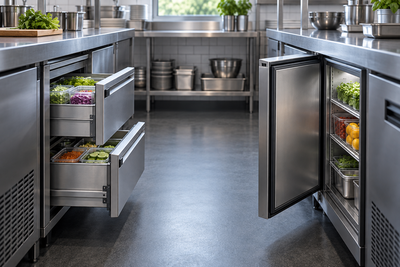
Adjustable 4 tier storage shelving gives a commercial kitchen four height-adjustable shelves on vertical posts, so you can store ingredients, cookware, small appliances and trays on a single footprint and reconfigure the spacing whenever your needs change. It is one of the simplest ways to turn unused vertical space into organised, hygienic storage that keeps stock off the floor and within easy reach.
📋 What this guide covers
- What adjustable 4 tier shelving is and how the modular design works
- Why four levels suit busy kitchens, bakeries and catering operations
- The main shelving types: chrome wire, stainless steel, polymer, heavy-duty and mobile
- How to choose, load and maintain shelving for hygiene and longevity
What is adjustable 4 tier storage shelving?
Adjustable 4 tier storage shelving is a modular system of four horizontal shelves supported by vertical posts. Each shelf can be repositioned to a different height, so you can store items of varying sizes without wasting space. As menus, equipment and stock levels change, you simply reset the shelf positions rather than buying a new unit.
In most kitchens these units handle:
- Dry ingredient storage: flour, sugar, tinned and packaged goods.
- Kitchen tools and cookware: pots, pans and prep equipment.
- Small appliances: mixers, blenders and benchtop units between uses.
- Cleaning supplies: kept in designated, separate areas.
- Bakery trays and containers: stacked neatly and easy to grab.
Why 4 tier shelving is essential in commercial kitchens
The value of four adjustable levels comes down to space, order and hygiene working together.
- Maximised vertical space: four levels lift storage capacity without taking up extra floor area.
- Better organisation: separating items by shelf cuts clutter and speeds up daily service.
- Flexible configuration: adjustable shelves adapt to different product heights as needs shift.
- Improved hygiene control: elevated storage keeps stock off the floor and supports sanitation standards.
- Faster workflow: a tidy, predictable layout reduces staff movement and search time during peak periods.
ℹ️ Storage off the floor is a food-safety basic
The FSANZ Food Standards Code requires food to be stored so it is protected from contamination. Keeping ingredients and equipment up on shelving, rather than on the floor, is one of the most practical ways to meet that expectation and pass inspections.
Key features of adjustable shelving systems
Professional-grade shelving is engineered for continuous use in demanding environments. Look for:
- Adjustable shelf heights for custom configurations.
- Heavy-duty metal or polymer construction that holds up to constant handling.
- Ventilated or solid shelf options depending on whether airflow or a flat surface matters more.
- High load-bearing capacity for stock and equipment.
- Corrosion-resistant finishes for wet and humid areas.
- Easy assembly and reconfiguration so the unit grows with you.
Types of adjustable 4 tier storage shelving
Matching the shelving material to the zone it sits in makes a real difference to durability and hygiene.
Chrome wire shelving
Ventilated wire shelves promote airflow and visibility, which makes them ideal for dry storage rooms.
Stainless steel shelving
Durable and hygienic, well suited to food prep and wash areas where surfaces need frequent cleaning.
Polymer shelving systems
Lightweight, rust-resistant and easy to clean, which suits cold rooms and wet areas.
Heavy-duty storage shelving
Built for bulk ingredients and heavier equipment that would overload lighter units.
Mobile shelving units
Shelving fitted with casters for kitchens that need to move storage around as service changes.
| Category | Description | Best for |
|---|---|---|
| Chrome wire shelving | Open design with airflow | Dry storage rooms |
| Stainless steel shelving | Hygienic and durable | Prep and wash areas |
| Polymer shelving | Corrosion-resistant | Cold rooms, wet areas |
| Heavy-duty shelving | High weight capacity | Bulk storage |
| Mobile shelving | Moveable configuration | Flexible kitchens |
How adjustable shelving supports kitchen workflow
Storage is closely tied to cleaning and preparation. Shelving units are often positioned near sinks and wash stations so staff can put cleaned equipment away the moment it is washed. Reliable drainage keeps those zones moving, so it pays to get the sink waste set-up right. Our guide to 90MM sink waste and basket drainage solutions explains how that fits together.
In bakeries and pastry kitchens, shelving works alongside transport gear to keep production moving. Trays, pans and ingredients move between prep areas, ovens and storage racks on dedicated carts, so shelving is commonly paired with a bakery trolley to maintain a smooth flow from preparation through to storage. You can browse the full range in our shelving and racking collection.
How to choose the right adjustable 4 tier storage shelving
- Assess storage needs: identify what you will store and how heavy it is.
- Measure available space: allow clearance for the shelves and for staff to move around them.
- Choose the right material: stainless steel for hygiene-critical zones, polymer for wet environments, and chrome wire shelving for ventilated dry storage.
- Consider load capacity: heavy-duty operations need reinforced designs.
- Plan for future expansion: modular shelving reconfigures easily as you grow.
🔧 Pro tip, load from the bottom up
Place the heaviest items on the lower shelves and keep frequently used stock at eye level. It lowers the centre of gravity for stability and saves your team from repeated bending and reaching during a rush.
Best practices for using 4 tier storage shelving
- Place heavier items on lower shelves.
- Keep frequently used items at eye level.
- Label shelves for quick identification.
- Maintain clear walkways around shelving units.
- Avoid overloading beyond the rated capacity.
Cleaning and maintenance tips
A few simple habits keep shelving performing for years:
- Clean shelves regularly according to the material type.
- Inspect joints and posts for stability.
- Adjust shelf heights as storage needs change.
- Replace damaged components promptly.
- Follow the manufacturer's cleaning guidelines.
⚠️ Do not exceed the rated load
Every shelf and post has a stated capacity. Overloading bows shelves, stresses joints and can lead to collapse. Spread heavy stock across the unit and respect the rating, especially on mobile shelving where movement adds strain.
Who should use adjustable 4 tier storage shelving?
These systems suit:
- Restaurants and cafés
- Bakeries and pastry kitchens
- Hotels and resorts
- Catering operations
- Institutional and commissary kitchens
Any operation that needs organised, flexible storage benefits from reliable 4 tier shelving.
Frequently Asked Questions
Adjustable shelves can be repositioned to fit changing storage needs, so a single unit handles tall and short items over time without being replaced.
Yes. Heavy-duty models are designed for bulk ingredients and equipment. Check the rated load per shelf and keep the heaviest stock on the lower levels.
Polymer and corrosion-resistant shelving systems are well suited to cold storage and other humid, wet environments.
Most systems are designed for quick assembly and easy reconfiguration, so you can set them up and adjust shelf heights without specialist tools.
Clean shelves regularly to suit the material, keep stock organised and off the floor, and inspect for spills or debris. Good organisation makes routine sanitation faster.