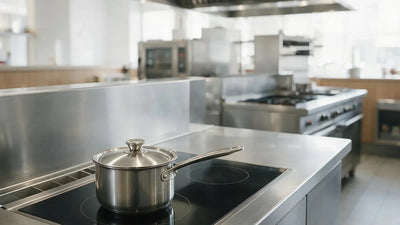
A Blue Seal and Waldorf infill bench is a stainless steel bench unit engineered to sit between commercial cooking equipment, such as ovens, fryers or cooktops, closing the gaps so the cooking line becomes one continuous, uniform surface. Because these benches are built to match the dimensions, height and finish of Blue Seal and Waldorf cooking suites, they remove wasted space, improve hygiene and give chefs extra prep and landing area exactly where it is needed.
📋 What this guide covers
- What an infill bench is and how it fits Blue Seal and Waldorf suites
- Why closing equipment gaps improves hygiene and workflow
- The main infill bench types and how they compare
- How to measure, choose and install one correctly
What is a Blue Seal and Waldorf infill bench?
An infill bench is a stainless steel unit designed to bridge the gap between two pieces of cooking equipment so the run reads as a single, level bench line. Blue Seal and Waldorf infill benches are sized and finished to align precisely with their respective cooking suites, which is what gives a fitted, integrated appearance across the line.
These benches are commonly used to eliminate unused gaps between appliances, provide extra prep or landing space, improve hygiene and ease of cleaning, and support a streamlined kitchen layout.
Why infill benches are essential in commercial kitchens
- Improved workflow: A continuous surface lets chefs move efficiently between stations.
- Enhanced hygiene: Closing gaps stops food debris, grease and liquids collecting between equipment.
- Better space utilisation: Otherwise wasted gaps become functional work areas.
- Professional appearance: A clean, cohesive line reflects industry standards.
- Equipment compatibility: Designed to align with Blue Seal and Waldorf cooking equipment.
ℹ️ The hidden cost of a gap
A narrow gap between two cooking units is one of the hardest spots in a kitchen to clean. Grease and food debris fall in and bake on, which is a recurring hygiene risk under the FSANZ Food Standards Code requirement to keep equipment clean. An infill bench removes the gap entirely, so there is nothing to trap.
Key features of Blue Seal and Waldorf infill benches
Commercial-grade infill benches are built to perform in demanding environments. Common features include:
- Heavy-duty stainless steel construction
- Precise height alignment with cooking equipment
- Reinforced frames for durability
- Smooth, easy-to-clean surfaces
- Optional undershelves or storage space
- Integration with adjacent appliances
Types of infill benches available
Different layouts need different infill solutions. The common types are:
Flat-top infill benches
A simple, continuous work surface between appliances.
Infill benches with undershelf
Add storage underneath for trays, pots or utensils.
Custom-width infill benches
Made to fill non-standard gaps between equipment.
Integrated storage infill benches
Combine gap-filling with open or enclosed storage.
| Type | Main function | Best for |
|---|---|---|
| Flat-top | Continuous bench surface | Cooking lines |
| With undershelf | Bench plus storage | Space-limited kitchens |
| Custom width | Non-standard gaps | Custom layouts |
| Integrated storage | Prep plus storage | High-volume kitchens |
How infill benches improve layout efficiency
In a busy kitchen, small inefficiencies add up over a shift. An infill bench keeps the workflow smooth by ensuring tools, ingredients and plated items can move easily along the cooking line without dead spots.
They become even more effective when paired with vertical storage. Many kitchens enhance their bench lines by adding overhead shelving above the run, putting seasonings and tools within arm's reach while keeping the bench clear.
Integrating infill benches with storage
Infill benches are often combined with under-bench or nearby storage to get the most from the space. Cabinets and shelves installed beneath or beside the benches let kitchens keep cookware, utensils and supplies exactly where they are used.
How to choose the right infill bench
- Measure equipment gaps: Accurate measurements ensure a precise fit between appliances.
- Match the equipment brand: Select models designed specifically for Blue Seal or Waldorf equipment.
- Consider storage needs: Decide whether an undershelf or enclosed storage is required.
- Evaluate load requirements: Make sure the bench supports your prep tools and cookware.
- Prioritise hygiene: Smooth stainless steel finishes are essential for food safety compliance.
🔧 Pro tip, measure the gap twice
Measure the opening at the front and the back of the run, not just one point. Cooking suites are not always perfectly square against a wall, and a custom-width infill bench ordered to the true gap will sit flush where a standard size leaves a sliver of space.
Installation best practices
- Align bench height with the adjacent equipment
- Secure benches firmly to prevent movement
- Ensure no gaps remain between surfaces
- Maintain clearance for cleaning access
- Follow manufacturer installation guidelines
Cleaning and maintenance
To keep infill benches in top condition:
- Wipe surfaces daily with food-safe cleaners
- Clean beneath and around benches regularly
- Inspect joints and seams for debris buildup
- Avoid abrasive cleaning tools
- Address dents or damage promptly
Who should use Blue Seal and Waldorf infill benches?
These benches suit restaurants with modular cooking lines, hotels and resorts, catering and event kitchens, institutional and healthcare foodservice, and any kitchen running Blue Seal or Waldorf equipment. They are especially valuable in high-output venues where cleanliness and workflow efficiency are critical.
Matching the bench to your cooking suite is the key step. View our Blue Seal cooking equipment and Waldorf cooking equipment ranges to confirm your line, then complete the layout with stainless steel benches and overhead over and undershelves.
Frequently Asked Questions
Yes. Models are designed to match specific equipment dimensions and finishes so they sit flush against the cooking suite. Choose an infill bench made for your Blue Seal or Waldorf line for the best fit.
Yes. Custom widths and configurations are available to fill non-standard gaps and suit unusual layouts. Accurate measurements of the opening are essential before ordering.
Yes. As well as closing gaps, they provide additional landing and prep surface along the cooking line, which is useful in tight kitchens where every bit of bench counts.
Yes. Stainless steel construction with smooth surfaces makes them simple to wipe down, and by removing gaps between equipment they eliminate the hard-to-reach spots where debris usually collects.
Yes. Many models include an undershelf or can be paired with cabinets, giving you storage in space that would otherwise sit empty between appliances.
To push your layout further, see our guide on bench overshelves for maximising vertical workspace above the line.