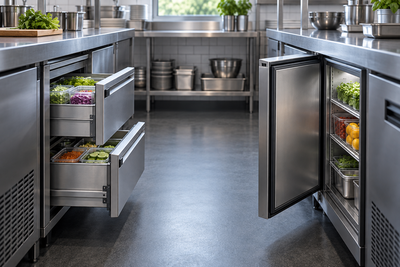
A commercial food warmer holds cooked food at a safe, consistent serving temperature without continuing to cook it, so dishes stay hot, moist and ready to plate through a long service. Unlike an oven, it applies gentle, steady heat to prevent drying and overcooking. That makes it essential for restaurants, cafés, hotels, catering operations and buffets, where food often needs to wait between the kitchen and the customer. The right type depends on what you serve and how much.
📋 What this guide covers
- What a food warmer does and how it differs from an oven
- The five main types and where each one fits
- The features worth checking before you buy
- How to choose the right warmer for your menu and volume
- Food safety, cleaning and common questions
What is a food warmer?
A food warmer is a commercial appliance designed to maintain the temperature of cooked food until it is served. Unlike ovens, which continue cooking, food warmers provide gentle, consistent heat that prevents overcooking while keeping food moist and safe. They are essential for high-volume service, buffets, catering events and any operation where food must remain hot before serving.
Types of commercial food warmers
1. Countertop food warmers
- Compact and ideal for cafés, kiosks and small restaurants
- Suited to holding smaller quantities such as side dishes or desserts
2. Floor-standing food warmers
- Large-capacity units for buffets, banquets and hotel kitchens
- Often equipped with multiple compartments to hold different dishes at once
3. Bain marie hot food bars
- Use water or steam to gently keep food hot without drying it out
- Well suited to sauces, soups and delicate dishes
For a deeper look at this format, see our bain marie and hot food bar guide, or browse the bain marie and hot food bars range.
4. Heated display cabinets
- Maintain food temperature while showcasing items to customers
- Ideal for grab-and-go operations and self-service counters
5. Portable food warmers
- Mobile units for catering events, banquets and temporary setups
- Maintain temperature during transport or outdoor service
Key features to consider
| Feature | Why it matters |
|---|---|
| Capacity | Match the unit size to your daily service needs |
| Temperature control | Adjustable settings for precise holding temperatures |
| Heating method | Dry heat, water bath or steam, depending on the food |
| Programmable controls | Pre-set temperatures for different dishes |
| Construction | Stainless steel for durability, hygiene and easy cleaning |
| Portability | Wheels or handles for easy movement |
| Safety features | Overheat protection, insulated handles and safety cut-offs |
ℹ️ Hold hot food at 60°C or above
Under the FSANZ Food Standards Code, potentially hazardous food should be kept at 60°C or hotter while hot-holding. A warmer with reliable thermostatic control makes meeting that requirement straightforward, and supports your temperature records.
Benefits of using a food warmer
- Keeps food safe: Maintains food at safe serving temperatures.
- Preserves quality: Prevents drying, overcooking and loss of flavour.
- Time-efficient: Lets kitchens prepare food in advance without rushing.
- Versatile: Suits main courses, sides, soups, sauces and desserts.
- Energy-efficient: Uses less energy than continuous cooking or reheating.
- Improves workflow: Multi-compartment units hold several dishes at once.
- Ideal for display: Heated cabinets maintain temperature while showcasing items.
How to choose the right food warmer
- Identify your needs: Determine the type of food and the volume to be held.
- Select the type: Countertop, floor-standing, bain-marie, display or portable.
- Check capacity: Ensure compartments and trays meet service requirements.
- Review controls: Thermostats and programmable options improve consistency.
- Consider heating method: Steam or water bath for delicate items, dry heat for robust dishes.
- Assess energy efficiency: Lower-consumption models reduce running costs.
- Maintenance and cleaning: Removable trays, drip pans and stainless steel surfaces simplify daily cleaning.
Popular uses of food warmers
- Hot entrees and side dishes
- Soups, sauces and gravies
- Desserts such as puddings or pastries
- Buffet and banquet service
- Catering events and outdoor service
- Grab-and-go and self-service counters
For specific holding formats, our pie warmers and heated display cabinets suit grab-and-go counters, while the broader hot holding and warming range covers larger setups.
Frequently Asked Questions
No. They are designed to hold food at serving temperature without further cooking, which is what keeps dishes from drying out or overcooking while they wait.
Yes. They use minimal energy compared with continuously reheating or cooking food, since they only need to maintain a holding temperature rather than apply full cooking heat.
Yes. Multi-compartment units and bain-marie systems let you keep several dishes hot at the same time, each in its own tray or section.
Countertop and portable models are compact and ideal for limited kitchen space, so even a small café or kiosk can hold food safely without a large footprint.
Remove the trays, wipe down the stainless steel surfaces and regularly descale water-based units where applicable to keep them running well and hygienic.