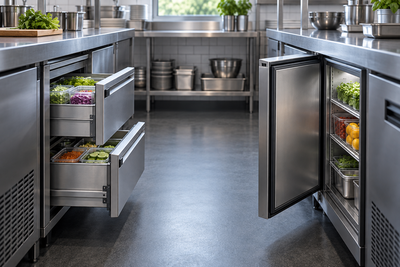
A dish wash entry/exit bench is a stainless steel bench system fitted to the entry and exit sides of a commercial dishwasher, giving dirty dishes a place to be sorted and staged on the way in, and clean dishes a place to be unloaded and dried on the way out. Used together, the two benches create a continuous one-directional workflow that cuts handling time, keeps dirty and clean items apart, and stops the dish pit becoming chaos during a rush. It is the backbone of an organised, hygienic and compliant dishwashing area.
📋 What this guide covers
- What entry and exit benches do and how they differ
- Why a defined dirty-to-clean flow matters for safety and speed
- Key features, configurations and how to choose
- Installation, cleaning and food safety considerations
What is a dish wash entry/exit bench?
A dish wash entry/exit bench is a stainless steel bench system installed at the entry and/or exit side of a commercial dishwasher. The entry bench is used for sorting and staging dirty dishes before washing, while the exit bench provides a clean, organised surface for unloading, air-drying or stacking items after washing.
Together, these benches form a continuous workflow that reduces handling time, improves cleanliness, and keeps the dishwashing area organised and compliant. Dirty items travel one way, clean items travel the other, and the two never cross.
Why dish wash entry/exit benches matter
A defined entry-to-exit layout does more than tidy the dish pit. It shapes safety, speed and staff comfort across every shift.
- Improved workflow efficiency: clearly defined entry and exit zones reduce congestion and confusion during peak service.
- Enhanced food safety: separating dirty and clean items minimises cross-contamination risk.
- Faster turnaround: dishes move smoothly through the wash cycle with minimal handling.
- Cleaner work areas: water management and a structured layout help keep floors and surfaces dry.
- Staff ergonomics: a correct bench height reduces strain and supports safer working conditions.
Key features of commercial entry/exit benches
Professional-grade benches are engineered for durability, hygiene and daily heavy use. Common features include:
- Food-grade stainless steel construction for corrosion resistance and easy sanitation.
- Integrated sinks or pre-rinse areas on the entry side.
- Sloped surfaces for water drainage.
- Raised edges or splashbacks to contain spills.
- Undershelves for storage of racks and trays.
- Left-hand or right-hand configurations to suit your machine.
- Seamless welded joints for easy cleaning.
Entry vs exit benches: the difference
Entry benches
Designed for handling dirty dishes, entry benches often include sinks, waste holes or pre-rinse spray areas. They help staff scrape, rinse and sort items efficiently before loading the dishwasher. For a deeper look at the dirty side, see our guide to the dish wash inlet bench with sink.
Exit benches
Exit benches provide a clean surface for unloading washed items. Some designs include racks, undershelves or open areas for air-drying and stacking. The companion dish wash outlet bench guide covers the clean side in detail. Using both entry and exit benches creates a complete, hygienic dishwashing workflow.
Bench configuration at a glance
| Bench type | Primary function | Best use case |
|---|---|---|
| Entry bench | Sorting and pre-rinse | High-volume washing |
| Exit bench | Unloading and drying | Fast turnaround service |
| Combined system | End-to-end flow | Large commercial kitchens |
| Custom layout | Tailored workflow | Complex kitchen designs |
How entry/exit benches improve operations
A strategically placed dish wash entry/exit bench minimises unnecessary movement and keeps dishwashing staff focused on a clear, repeatable process. Dirty items move in one direction, clean items move out, and the crossover and confusion disappear.
That organised flow is especially important during busy service periods, when rapid dish turnover is essential to maintaining front-of-house efficiency.
🔧 Pro tip, commit to one direction
Design the dish pit so there is only one logical path: dirty in at the entry, clean out at the exit. When staff never have to backtrack across the machine, both throughput and hygiene improve without anyone having to think about it.
Materials and construction quality
Why stainless steel
Stainless steel is the preferred material for its corrosion resistance, strength and hygienic surface.
Structural stability
Reinforced frames support heavy dish loads and constant use without flexing.
Drainage design
Sloped surfaces and waste outlets manage water effectively, keeping the area drier and safer.
Seamless welding
Smooth joints reduce bacteria traps and simplify sanitation.
How to choose the right entry/exit bench
When selecting benches for your dishwashing area, weigh up these factors:
- Dishwasher size and orientation: ensure the bench aligns with your dishwasher's entry or exit side.
- Available space: measure the floor area so walkways stay clear.
- Volume of dishes: higher volumes may call for longer benches or undershelves.
- Plumbing requirements: entry benches with sinks need proper drainage connections.
- Compliance standards: choose designs that meet local food safety and health regulations.
You will find matching units in our inlet and outlet benches range, and broader fabricated stainless options across the stainless steel collection.
Installation and placement tips
- Confirm left-hand or right-hand configuration before fitting.
- Ensure proper levelling for water drainage.
- Maintain separation between dirty and clean zones.
- Allow access for cleaning behind and underneath.
- Follow manufacturer and local installation guidelines.
Cleaning and maintenance best practices
To keep dishwashing areas hygienic and efficient:
- Clean benches daily with food-safe cleaners.
- Flush and sanitise sinks and waste outlets.
- Avoid abrasive tools that damage surfaces.
- Inspect welds and joints regularly.
- Address corrosion or damage promptly.
ℹ️ Who benefits most
Entry/exit benches suit restaurants and cafés, hotels and resorts, catering and banquet kitchens, hospitals and aged-care facilities, and institutional or school kitchens. Any operation with high dish turnover gains from a structured dishwashing workflow. Tight on space? Our guide to corner benches covers layout tricks for compact kitchens.
Frequently Asked Questions
It is not mandatory, but using both creates the most efficient and hygienic workflow by giving dirty and clean dishes their own dedicated zones.
Yes. Many suppliers offer custom sizing and configurations to match specific dishwasher models and kitchen layouts.
Most are designed to work with standard commercial dishwashers, but measurements should be confirmed against your specific machine before ordering.
Not always, but sinks and pre-rinse areas are common on entry benches for high-volume operations where scraping and soaking happen before the wash.
They demonstrate a clear separation of dirty and clean zones, a core hygiene principle under the FSANZ Food Standards Code, which supports auditable food safety compliance.