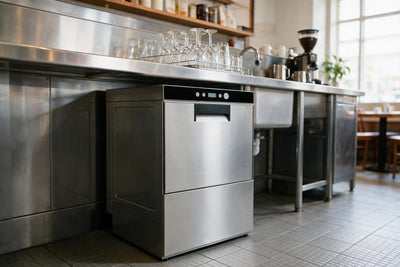
A pot and pan dishwasher is a heavy-duty commercial warewasher built to clean large cookware such as stock pots, pans, trays, gastronorm containers and other oversized kitchen equipment. Compared with a standard dishwasher, it uses a larger washing chamber, stronger spray pressure and longer, more intensive cycles to lift stubborn grease and burnt-on residue. For restaurants, hotels, bakeries, catering services and food production sites, it is the machine that keeps a busy kitchen clean, compliant and moving.
📋 What this guide covers
- What a pot and pan dishwasher is and how it differs from a standard unit
- Why heavy cookware needs a dedicated machine
- The features that drive cleaning power and sanitation
- The main machine types and how to choose between them
- Maintenance habits that protect your investment
What is a pot and pan dishwasher?
A pot and pan dishwasher is a heavy-duty commercial system designed specifically for large cookware that does not fit, or cannot be cleaned effectively, in a standard warewasher. Compared with a typical machine, these units offer:
- Extra-large internal chambers
- Powerful wash pumps
- Higher operating temperatures
- Longer, more aggressive wash cycles
- Stronger spray arms built to remove baked-on residue
They suit kitchens that handle large-batch cooking or continuous production, where manual scrubbing would be too slow, inconsistent or labour-intensive to keep up.
Why a busy kitchen needs one
Choosing the right pot and pan dishwasher is more than a convenience upgrade. It directly affects kitchen efficiency, safety and sanitation.
1. Higher productivity
Manual scrubbing burns through staff hours. These machines automate the cleaning of bulky cookware so your team can focus on prep and service.
2. Reliable sanitation
Most units reach high rinse temperatures for food-safe sanitation, so cookware comes out clean and ready for immediate reuse.
3. Consistency under load
Stubborn grease, carbon deposits and dried sauces are removed cycle after cycle, with results that hold up no matter how busy the kitchen gets.
4. Built for large items
Sheet pans, mixing bowls, deep pots and gastronorm trays fit easily, which standard dishwashers cannot accommodate.
5. Lower labour costs
Less manual washing means fewer staff tied to the sink and lower long-term labour expenses.
Key features to look for
Knowing which features deliver the most value makes the comparison far simpler.
- Capacity and chamber size: a chamber that fits your largest cookware, so check dimensions carefully for extra-tall or extra-wide pieces
- Cycle time options: light for lightly soiled items, normal for everyday pots and pans, and intensive for baked-on grease, carbon or proteins
- Heating system: electric, steam, or gas-powered (less common), chosen to match your utilities and energy goals
- Pump power and water pressure: higher gallons-per-minute (GPM) ratings and multi-arm spray systems clean better
- Rinse booster and temperature control: a final rinse of 180°F (82°C) is ideal for sanitation, and many machines include a booster to hold it
- Stainless steel construction: increases durability, reduces corrosion and supports long-term hygiene
- Ergonomic loading: side-loading and front-loading models suit different kitchen layouts
ℹ️ Why the 82°C rinse matters
A high-temperature final rinse is what sanitises cookware after washing. A built-in booster heater keeps the rinse at the target temperature even when incoming water is cold, which is why booster compatibility is worth confirming before you buy.
Types of pot and pan dishwashers
Each configuration is built for a different scale and layout.
Hood-type pot and pan systems
Designed for medium to high-volume kitchens, with a larger chamber than standard hood-type dishwashers.
Front-loading heavy-duty washers
Ideal for kitchens with limited space, since they tuck under or against a bench.
Tunnel or conveyor systems
Built for industrial food production, offering continuous washing with extremely high throughput.
Soak-and-wash combo units
Suited to bakeries and pastry kitchens, where burnt-on sugar and dough residue need soaking first.
| Type | Best suited to | Strength |
|---|---|---|
| Hood-type | Medium to high-volume kitchens | Large chamber, fast turnover |
| Front-loading | Space-limited kitchens | Compact footprint |
| Tunnel / conveyor | Industrial production | ✓ Highest throughput |
| Soak-and-wash combo | Bakeries and pastry kitchens | Tackles baked-on sugar and dough |
How to choose the right model
Work through these checks in order before you shortlist.
1. Evaluate your cookware load
Count how many large pots, pans, trays and containers you wash daily, and size the machine for peak volume rather than average.
2. Measure your largest items
Confirm your tallest and widest cookware fits comfortably inside the chamber.
3. Consider your kitchen layout
Review available space, water access, drainage and power, then choose a configuration (front-load, hood-type or pass-through) that integrates cleanly into your workflow.
4. Compare water and energy efficiency
Lower consumption reduces operating costs and supports sustainability goals.
5. Check for smart technology
Some modern units include digital control panels, auto-diagnostics, real-time temperature monitoring and programmable cleaning cycles.
6. Evaluate noise levels
This matters in open-kitchen or café environments where the machine sits near customers.
7. Factor in maintenance and servicing
Choose a model with accessible components and reliable after-sales support.
Maintenance tips for longevity
A well-maintained pot and pan dishwasher performs better and lasts significantly longer. Build these habits into the daily routine.
- Clean filters daily
- Check spray arms for blockages
- Use manufacturer-approved chemicals
- Descale regularly in hard-water areas
- Inspect gaskets and seals monthly
- Keep the machine dry between shifts
These small habits reduce breakdowns and protect your investment over the life of the machine.
Frequently Asked Questions
It has a larger chamber, stronger pump power and higher temperatures designed to remove heavy soil and grease from bulky cookware that a standard dishwasher cannot handle.
Yes. Many models include racks and inserts for ladles, whisks, spatulas and other utensils, so you can clean smaller items alongside large cookware.
No, but units without one may struggle to reach proper sanitation temperatures. If your incoming water is not hot enough, a booster heater helps hold the 82°C rinse needed for food-safe results.
Anywhere from 2 to 15 minutes, depending on soil levels and machine type. Heavily soiled cookware on an intensive cycle sits at the longer end of that range.
If your kitchen handles large cookware daily, it significantly improves efficiency and cleanliness. A compact front-loading model can bring heavy-duty washing to a small kitchen without a large footprint.
The right heavy-duty washer depends on your cookware load and layout. Browse our pot and utensil washers and the wider commercial dishwasher range. For high-volume dishware, our guide to pass through dishwashers is a useful companion, and you can compare enclosed options in our hood-type dishwasher guide.