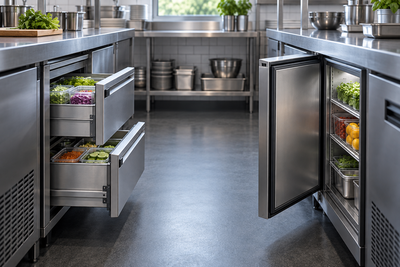
Choosing the right commercial refrigeration system comes down to matching four things to your business: the type of food you store, the space you have, the storage capacity you need, and the temperature zones your menu demands. Get those right, weigh them against energy efficiency and budget, and you end up with a system that keeps stock fresh, meets food-safety requirements and runs at a sensible cost. This guide walks through each decision in order.
📋 What this guide covers
- How to assess your refrigeration needs before you buy
- The main types of commercial refrigeration and what each suits
- Balancing budget against energy efficiency and reliability
- Maintenance, support and compliance with food-safety rules
Assess your needs first
Before you compare models, get clear on what your business actually requires. Five factors do most of the work here.
- Type of business: A restaurant, a supermarket and a bakery all store different products in different volumes, so each has different refrigeration needs.
- Space: Measure the available footprint accurately. Confirm the equipment will fit comfortably, with room for ventilation and door clearance.
- Storage capacity: Work out how much you need to store based on your typical stock volume and delivery cycle.
- Temperature zones: Identify whether you need separate zones for frozen, refrigerated and chilled products.
- Energy efficiency: Refrigeration runs around the clock, so an efficient model has a real impact on operating costs.
🔧 Pro tip, size for your busiest week
Spec capacity around your peak trading period, not your average. A fridge that copes most of the year but overflows during your busiest week forces staff to over-stack, which blocks airflow and pushes temperatures up.
Types of commercial refrigeration
There is a format for almost every need. The common options each solve a particular problem.
| Type | Best for | Key benefit |
|---|---|---|
| Reach-in fridges and freezers | General perishable storage | Versatile sizing with easy access |
| Walk-in coolers and freezers | High-volume operations | Large, scalable storage capacity |
| Undercounter and bench units | Smaller kitchens | Saves floor space under the bench |
| Display refrigerators | Front-of-house sales | Showcases product behind glass |
| Blast chillers | Rapid cooling of hot food | Preserves quality and meets safety rules |
| Refrigerated prep tables | Salad, pizza, sandwich lines | Combines prep surface with chilled storage |
- Reach-in refrigerators and freezers: Versatile, available in a range of sizes and ideal for perishable items with easy access. Browse commercial fridges.
- Walk-in coolers and freezers: Larger systems that provide substantial storage for businesses moving high volumes of refrigerated or frozen goods. Explore cool rooms and freezer rooms.
- Undercounter and bench units: Compact units that fit beneath countertops, a smart way to save space in smaller kitchens.
- Display refrigerators: Glass-door units for showcasing beverages, desserts or deli items where presentation drives sales.
- Blast chillers: Essential for rapidly cooling hot food, which preserves quality and helps you meet food-safety standards. See blast chillers.
- Refrigerated prep tables: Combine a prep surface with chilled storage, ideal for salad bars, pizza stations and sandwich preparation.
Consider your budget
Prices vary widely, so set a budget before you shop. The cheapest unit is rarely the best value. A more efficient, reliable system often costs less over its life through lower energy bills and fewer breakdowns, so weigh upfront cost against long-term performance.
Energy efficiency
Energy-efficient refrigeration saves on utility bills and supports a more sustainable operation. Look for models with recognised energy certification, which signals compliance with efficiency standards. Features like LED lighting, automatic door closers and smart temperature controls all help trim consumption.
ℹ️ Why efficiency adds up
Refrigeration is one of the few pieces of kitchen equipment that runs 24 hours a day, every day. Small efficiency gains compound across the year, which is why door seals, lighting and control quality matter as much as headline price.
Maintenance and support
Regular maintenance protects both the lifespan and the efficiency of your system. When you choose a model, check the availability of local service technicians and spare parts. Many manufacturers offer maintenance contracts or extended warranties, which give peace of mind and help avoid surprise repair bills.
Compliance with regulations
Make sure your chosen system meets local health and safety requirements for temperature control and storage. Non-compliance can lead to fines and, more seriously, puts food safety at risk. Reliable temperature holding and monitoring are part of staying compliant.
⚠️ Keep cold food cold
Under the FSANZ Food Standards Code, cold ready-to-eat food should be held at 5°C or below. Your refrigeration needs the capacity and airflow to maintain that even when fully loaded during peak periods.
Frequently Asked Questions
Under the FSANZ Food Standards Code, cold ready-to-eat food should be held at 5°C or below. Choose a system that can maintain this reliably even when fully stocked.
Reach-in fridges suit general perishable storage and smaller footprints. Walk-in coolers and freezers suit high-volume operations that need substantial, scalable capacity. Many venues use both.
If you cook food in advance and need to cool it quickly, a blast chiller is worth it. Rapid cooling preserves quality and helps you meet food-safety standards for moving food safely through the danger zone.
Choose energy-certified models, keep door seals in good condition, avoid over-stacking that blocks airflow, and use features like LED lighting and automatic door closers. Regular maintenance keeps the system running efficiently.