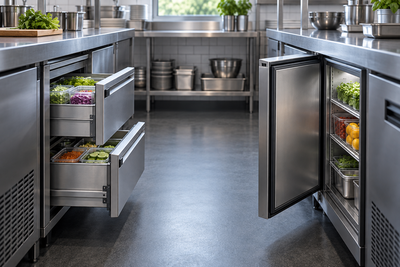
A folding table is a portable, collapsible work surface that gives a commercial kitchen or catering operation extra prep, plating or service space on demand, then folds flat for storage when the rush is over. Built tougher than the domestic versions, commercial folding tables handle daily professional use while staying quick to set up, easy to move and simple to keep clean.
📋 What this guide covers
- What a folding table is and where it earns its place
- The main folding table types and materials
- How folding tables improve workflow and support hygiene
- How to choose the right table for your operation
- Setup, cleaning and maintenance best practice
What is a folding table?
A folding table is a work surface with collapsible legs or a folding frame, so it can be set up, folded down and stored quickly. In commercial settings these tables use stronger materials and frames than residential models, which lets them stand up to constant professional use.
They are commonly found in:
- Commercial kitchens: extra prep space when service peaks
- Catering operations: portable stations for off-site jobs
- Event venues: fast, temporary layouts
- Temporary food prep areas: pop-ups and seasonal trade
- Back-of-house support zones: overflow work surfaces
Why folding tables are essential in professional kitchens
Foodservice demand rarely stays flat. Busy service hours, special events and catering jobs all call for more bench space than the fixed layout provides. A folding table answers that without permanent installation or remodelling.
- Quick setup and breakdown: ready in minutes, away just as fast
- Efficient use of limited space: stored flat, they free up floor area
- Support for temporary workflows: extra stations exactly when needed
- Easy transport: ideal for off-site catering and events
🔧 Pro tip, keep a stainless model for raw food prep
Reserve a stainless steel folding table for handling raw proteins and produce. Its non-porous surface sanitises properly between tasks, which is harder to guarantee on a poly top used for mixed duties.
Types of folding table
Picking the right format depends on load, hygiene needs and how often the table travels:
- Standard folding tables: flat surfaces for general prep and service tasks
- Heavy-duty folding tables: reinforced frames for higher load capacity
- Stainless steel folding tables: built for food prep where hygiene is strict
- Adjustable height folding tables: ergonomic flexibility across tasks
- Catering folding tables: designed for easy transport and fast event setup
Folding table material options
| Material | Key advantages | Best use |
|---|---|---|
| Stainless steel | Hygienic, corrosion-resistant | ✓ Food prep areas |
| Poly or plastic top | Lightweight, easy to clean | Catering and events |
| Reinforced steel frame | High load support | Heavy-duty applications |
The right material comes down to how and where the table will be used. Stainless suits prep zones; a lighter poly top is easier to carry to an off-site event.
How folding tables improve kitchen workflow
In a fast kitchen, flexibility feeds productivity. Folding tables create temporary prep stations, ease congestion around permanent benches, let staff run parallel tasks and allow quick layout changes between services.
They work best alongside stable support gear. Where heavy appliances need a fixed home, commercial floor stands for sturdy equipment support keep machinery secure while folding tables flex around them, so the workspace stays both organised and adaptable.
Food safety and hygiene considerations
Commercial folding tables are designed to support food safety, and under the Australia New Zealand Food Standards Code (Standard 3.2.2) food contact surfaces must be kept clean and able to be sanitised. Folding tables help by:
- Offering smooth, easy-to-clean surfaces
- Allowing proper sanitation between uses
- Supporting organised prep workflows
- Reducing clutter in fixed work areas
ℹ️ Stainless steel suits strict hygiene zones
Where raw and ready-to-eat foods share a kitchen, a non-porous stainless surface is the safer choice because it can be cleaned and sanitised thoroughly between tasks.
How to choose the right folding table
Weigh these factors before you buy:
- Load capacity: it must safely hold your ingredients, equipment or service items
- Tabletop material: prep areas need non-porous, food-safe surfaces
- Frame strength: reinforced frames give better stability for demanding tasks
- Storage space: choose sizes that fit your available storage when folded
- Intended use: prep, catering and service can each call for a different design
⚠️ Mind the load limit
Heavy-duty folding tables handle moderate equipment, but very heavy appliances belong on fixed benches or floor stands. Always set the table on a level surface and lock the legs before loading it.
Setup, cleaning and maintenance
Good handling extends the lifespan of any folding table:
- Always set tables on level surfaces and lock the legs before use
- Avoid exceeding the rated load limit
- Clean and sanitise surfaces before and after use with food-safe products
- Inspect hinges and locking mechanisms regularly, and tighten bolts as needed
- Store folded in dry areas, away from prolonged moisture
Complementary equipment for better operations
Folding tables work best beside the right support gear. For organised dishware handling, our gastronorm dish cassette guide shows how to protect and move GN pans, while the gastronorm storage range supplies the containers themselves. To round out a flexible setup, browse our folding tables and pair them with structured storage for smoother service during busy periods.
Frequently Asked Questions
Yes, especially stainless steel models designed for commercial kitchens, which offer the non-porous surfaces needed for safe food prep.
Heavy-duty models support moderate equipment, but very heavy appliances should sit on fixed benches or floor stands designed for that load.
Yes. They are built for portability and quick setup, which makes them well suited to off-site catering and events.
Commercial models with food-safe surfaces meet hygiene requirements when properly cleaned and sanitised between uses.
No. They are widely used in restaurants, hotels and prep areas as well, anywhere a kitchen needs flexible extra workspace.