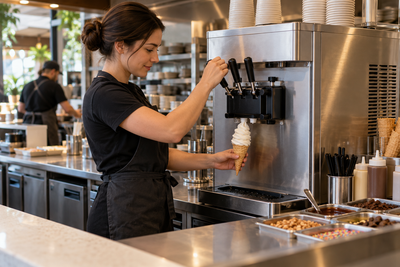
AI-generated underbench freezer concept reused from Atlantic’s bench-fit guide. It provides equipment context; it is not a named model, the fictional stock plan, a customer venue or evidence of pack capacity, temperatures or an assessed installation.
There are ten packs in the kitchen and ten packs needed for service. Yet one request goes short—and a pack is still sitting in the freezer at the end. The problem is not necessarily total storage. It can be where the stock is when the station needs it.
An underbench freezer earns its place when its usable station stock and replenishment plan work together. Count what must be available before the next confirmed refill, then check the reserve separately. A freezer beside the task can make stock accessible there; it cannot supply a pack that has not arrived or create reserve stock that was never purchased.
Separate the station quantity from the kitchen total
Start with a defined frozen product and its actual pack. Record the opening quantity at the station, the quantity reserved elsewhere for that station, the expected withdrawals and when a replenishment can actually be completed. Keep stock promised to another station out of this reserve.
The purchasing question is more useful than “How many litres do we need?”: what must this station hold between replenishments, and can that exact stock be stored and retrieved in the offered configuration? A large kitchen total can conceal an empty station. A perfectly timed refill can still leave the whole kitchen short.
Use the commercial freezer buying guide for the wider stock and format decision. This guide follows the quantity through service so the underbench purchase has a clear role alongside reserve storage.
Worked stock draw: enough packs, delivered too late
The kitchen, times and quantities below are fictional. They track one defined type of sealed, already-frozen pack, counted as whole packs throughout. One pack issued satisfies one pack requested. The example has no returns, losses, substitutions, incoming supplier delivery or other station using the reserve. An unfilled request remains recorded as unfilled; later stock does not retrospectively satisfy it.
At 12:00 the station starts with six packs and a separate reserve has four. The three required withdrawals are four packs at 12:15, three at 12:30 and three at 12:45: ten packs in total. The paper stock allocation permits a maximum of six at the station. That six-pack allocation is an example assumption to test against a real loaded cabinet, not a model capacity or instruction to fill any freezer this way.
In Plan A, all four reserve packs arrive at the station at 12:35. “Arrive” means the replenishment is complete and those packs are available for the station's next withdrawal. The time is an invented event, not a transfer duration or food-handling method.
| Event | Station before event | Received / requested | Issued / unfilled | Station after event | Reserve left |
|---|---|---|---|---|---|
| 12:00 opening | — | 6 opening packs | — | 6 | 4 |
| 12:15 withdrawal | 6 | 4 requested | 4 issued / 0 unfilled | 2 | 4 |
| 12:30 withdrawal | 2 | 3 requested | 2 issued / 1 unfilled | 0 | 4 |
| 12:35 refill complete | 0 | 4 received | — | 4 | 0 |
| 12:45 withdrawal | 4 | 3 requested | 3 issued / 0 unfilled | 1 | 0 |
Scroll the table sideways to see every column.
Plan A issues 4 + 2 + 3 = nine packs, leaves one request unfilled and finishes with one pack at the station. The stock balances: six opening + four received = nine issued + one remaining. The missed request occurred at 12:30, while all four reserve packs were still elsewhere.
Do not specify a larger cabinet solely because this plan ran short. First test whether replenishment can be completed before the second withdrawal with the actual people, route and stock responsibilities. In this example, the station did not lack room for the later refill; it lacked stock at the required moment.
Move the replenishment, then check every balance
Plan B keeps the same six-pack station allocation and the same ten-pack kitchen total. It moves the completed refill to 12:25, after the first withdrawal and before the second. There are two packs at the station when four arrive, so the quantity returns to six and stays within the example allocation.
| Event | Station before event | Received / requested | Issued / unfilled | Station after event | Reserve left |
|---|---|---|---|---|---|
| 12:00 opening | — | 6 opening packs | — | 6 | 4 |
| 12:15 withdrawal | 6 | 4 requested | 4 issued / 0 unfilled | 2 | 4 |
| 12:25 refill complete | 2 | 4 received | — | 6 | 0 |
| 12:30 withdrawal | 6 | 3 requested | 3 issued / 0 unfilled | 3 | 0 |
| 12:45 withdrawal | 3 | 3 requested | 3 issued / 0 unfilled | 0 | 0 |
Scroll the table sideways to see every column.
Plan B supplies all ten requested packs and ends at zero: six opening + four received = ten issued. It resolves the quantity-and-timing problem in this paper example. It leaves no remaining stock buffer for an additional request. Decide any contingency from the venue's real demand and supply evidence rather than adding an unexplained percentage.
The practical next step is to establish whether the proposed refill can be completed by 12:25 while the rest of the kitchen works. Name the person, reserve location, stock allocation and destination. A diary entry does not establish that the route, workload or food-handling arrangements support it; the venue and relevant providers assess those for the actual task.
An earlier refill cannot fix a reserve shortage
Now change one input: the reserve has only three packs. Keep the six opening packs and the earlier 12:25 refill. The station has two after the first withdrawal, receives three to make five, issues three at 12:30 and has two left for the final request of three.
| Scenario | Opening + reserve | Issued by required events | Unfilled / ending stock | Buyer action |
|---|---|---|---|---|
| A: refill complete 12:35 | 6 + 4 = 10 | 9 of 10 | 1 unfilled / 1 left | Investigate replenishment timing before assuming cabinet volume is the cause |
| B: refill complete 12:25 | 6 + 4 = 10 | 10 of 10 | 0 unfilled / 0 left | Verify the six-pack loaded arrangement and complete refill task; assess contingency separately |
| C: earlier refill, smaller reserve | 6 + 3 = 9 | 9 of 10 | 1 unfilled / 0 left | Resolve the one-pack supply shortfall or deliberately change the requirement; cabinet size alone adds no stock |
Scroll the table sideways to see every column.
Before spending on extra station capacity, identify which problem the money would address. If no refill can happen before 12:30, the station needs seven packs available before the first two withdrawals in this example: four + three. That exceeds the assumed six-pack allocation by one. Reassess the actual loaded arrangement, replenishment arrangements or service requirement. Do not force a seventh pack into an unassessed space.
Specify usable pack storage, not just litres
Send the supplier the actual pack dimensions including projections, weights, quantities and required retrieval order. Ask it to mark the proposed station stock on the offered shelf or drawer arrangement and identify the applicable loading and internal airflow requirements. Show the refill quantity arriving while the remaining stock is still there.
SKOPE's PG11.UBF.3.SD.RH specification sheet separates gross volume from door-opening and shelving information. Its ProSpec user guide, PRN80218 revision 3.2, addresses shelf loading and internal airflow separately. These documents illustrate why a litre figure alone does not establish the usable pack arrangement. They do not establish the six-pack allocation or refill timing used here.
Use the bench-freezer enclosure and pack-fit guide to assess the surrounding bench and entry opening. Keep this guide's stock balance alongside that drawing: a suitable cabinet arrangement and enough stock at the right time are both needed for the purchasing brief.
Take the replenishment brief to the supplier
Our station needs four packs at 12:15, three at 12:30 and three at 12:45. We propose six opening packs plus four reserve packs, with the refill complete at 12:25. Please assess the exact model and loaded arrangement for those packs, including the refill arriving when two remain. Identify the model documents, mounting/site requirements and unresolved loading or access questions in the quote.
Replace those numbers with your own stock record. Add the named refill owner, reserve location and stock committed to other stations. Record the latest completed refill time the venue can support, how unmet requests are handled, and what changes if the menu, pack, reserve quantity or staff duties change. Keep the food process and transfer arrangements with the people responsible for the venue's food-safety procedures; a quantity balance does not establish them.
Discuss the station and reserve brief with Atlantic Equipment, or compare the underbench freezer range with your pack record beside it. The useful advantage to seek is stock available for the actual station task, supported by a replenishment plan the kitchen can deliver.
About this guide
Prepared by Atlantic Equipment. This guide helps buyers distinguish station capacity, replenishment timing and reserve-stock shortfalls when purchasing underbench frozen storage. All stock, allocation and time examples are fictional; no venue trial, product capacity, temperature result or food-handling approval is represented. The named SKOPE specification sheet and user guide were read on 18 October 2026 for their separate volume, opening, shelving, loading and airflow information. Use actual stock records, current model documents and the responsible venue and supplier assessments for the purchase.