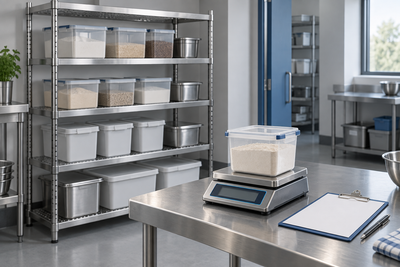
Existing AI-generated station concept for context, not either rack-stand offer or the worked access layout. It does not establish rack support, collection performance or an approved workplace arrangement.
The rack stand fits beside the dishwasher. Then the door opens, someone needs the lower rack, and the collection trolley arrives. The stand has enough places on paper; the staff have nowhere useful to work.
Choose a dishwash basket stand for the racks waiting there and the complete access task. Establish the collection pattern, matched rack support, access to every required position and the surrounding staff route. A stand's rack count is not a dishwasher's racks-per-hour rating.
Start with the racks that actually wait for collection
The useful question is not “How many racks do we own?” It is “How many need a supported place here before someone collects them?” Name the stand's role: empty-rack supply, a nominated collection point or another defined task. Do not combine incompatible clean and soiled flows merely to fill unused positions.
In this guide, a position means one place the proposed stand is documented to support for the specified rack and load. It does not mean a shelf can take an arbitrary stack. A rack stand, a stack-transport dolly and a base supporting the dishwasher itself are different items; a listing headed “dishwasher stand” needs that distinction checked.
Write down the actual rack models, contents and loaded masses, when they arrive, who collects them and their destination. For the machine's separate capacity decision, use the peak-service dishwasher rack guide. Here the dishwasher's cycle is outside the calculation.
Worked collection plan: four waiting racks, or three?
All events, offers and arrangements below are fictional. The example is a nominated rack collection point, starting with one rack waiting. Seven more arrive during the window. The record tracks arrival at this point, not washing cycles, drying conditions or readiness for reuse.
| Minute / event | New arrivals | Original collection | Original waiting | Revised collection | Revised waiting |
|---|---|---|---|---|---|
| 0: opening | — | 0 | 1 | 0 | 1 |
| 4: arrival | 2 | 0 | 3 | 0 | 3 |
| 6: collection | 0 | 2 | 1 | 3 | 0 |
| 8: arrival | 3 | 0 | 4 | 0 | 3 |
| 10: collection | 0 | 2 | 2 | 2 | 1 |
| 12: arrival | 2 | 0 | 4 | 0 | 3 |
| 14: collection | 0 | 4 | 0 | 3 | 0 |
Scroll the table sideways to see every column.
Both plans reconcile: one opening rack + seven arrivals = eight collected + zero left. Original collection is 2 + 2 + 4 = 8; revised collection is 3 + 2 + 3 = 8. The original peak is four waiting racks, at minutes 8 and 12. The revised peak is three.
The revised plan changes a real obligation: someone must collect three racks at minute 6 instead of two. That person's availability, the receiving destination and the supported transfer arrangement still need evidence. Moving a number between columns has not created extra staff time or transport capacity.
| Offer | Documented positions in this example | Original collection plan | Revised collection plan |
|---|---|---|---|
| A | 3 matched rack positions | Short by one at each four-rack peak | Meets the count only if the changed collection is achievable |
| B | 4 matched rack positions | Meets the count, with no spare position at either peak | One spare position at the three-rack peak |
Scroll the table sideways to see every column.
Choose B for further assessment if the original collection commitment must remain. Keep A in the comparison if the revised pickup can genuinely be supported. Neither is accepted until rack compatibility, load support and staff access are resolved. If collection is delayed, replay that actual delay in the ledger rather than treating the spare position as a universal allowance.
Match the rack support, not just the nominal square
Give the supplier the exact rack identification and an actual example. Compare the support interface, retaining features, loaded outline and required removal movement. A nominal rack size alone does not establish how its base sits on rails or whether the chosen contents clear the next position.
Ask for the offered stand's supported rack configuration, rated load conditions and applicable instructions. Check the fully loaded assembly as well as each position. Do not derive a permitted stack height from the photograph, or divide a total load rating into an assumed number of interchangeable shelves.
Cambro's current Camdollies for Dish Racks page illustrates why the details matter. Its global specification table distinguishes exterior dimensions, interior dimensions, load rating and wheel arrangements across named models. Several configurations list no brakes; another lists a brake on one caster. That is a prompt to identify the exact offered configuration, not a recommendation that a particular dolly suits this collection point or that every wheeled stand has lockable wheels.
Material is also a model-specific fact. The same manufacturer describes a plastic rack-dolly construction, so stainless steel is not a universal definition of a commercial rack support. Compare documented construction, permitted care and suitability for the intended environment rather than judging the product from a material label alone.
Mock up access with the dishwasher open
A footprint rectangle shows where the stand parks. Add the movements that make it useful: the dishwasher's opening envelope, rack withdrawal, the operator's task space and the collector's approach. Then include the next person who needs the same area. For a mobile proposal, include the complete permitted movement and parking arrangement.
| Proposed location | Task to represent | Conflict found in the fictional plan | Next decision |
|---|---|---|---|
| Stand opposite the machine | Open the dishwasher and access the lowest required rack position | The drawn door envelope overlaps the rack-withdrawal area | Reject this location; a larger rack count does not remove the overlap |
| Stand at the end of the landing bench | Collect from every required position while the operator uses the station | The drawing no longer has that door overlap; staff access remains untested | Arrange a representative task assessment with the responsible team |
| Mobile stand in the same end position | Approach, position, collect and leave by the intended route | The handle, turning movement, floor transitions and destination are not yet represented | Add the complete movement envelope and matched instructions before choosing mobility |
Scroll the table sideways to see every column.
Test the actual rack that is hardest to retrieve, not only the easiest top position. If accessing one rack requires moving another, record where that rack goes and who handles it. A plan that quietly borrows the dishwasher's landing area may fail as soon as both tasks happen together.
SafeWork NSW's hazardous manual tasks guidance includes pushing and pulling as well as lifting, and identifies force, repetition and awkward posture among the relevant risk factors. It supports involving workers and assessing the complete task. Wheels or a raised support do not, by themselves, demonstrate a safer job.
Have the responsible workplace team assess the actual users, loads, floor and route. This mock-up supplies no universal stand height, aisle width, safe load, stacking method or clearance. If the task cannot be supported in the available location, change the collection arrangement or station layout before paying for a stand that only fits when idle.
Keep the stand decision separate from machine performance
The worked ledger changes where racks wait and when they leave. It does not change a wash programme, establish a hygienic storage process or prove that staff can wash more racks per hour. Those are separate decisions needing their own evidence.
Record which task the proposal improves and what will demonstrate it: a required rack can be retrieved without conflicting with another nominated task, the collection plan has a supported destination, or a specific access conflict is removed. Keep unresolved observations visible rather than converting a tidier drawing into a speed or injury-reduction claim.
Price the exact rack support and supplied configuration. Name included rails, wheels, handles, retaining features and any required accessories; identify assembly, delivery, positioning, care instructions and service responsibilities. Establish the proposed brake or restraint arrangement from the actual instructions and site assessment, not generic advice for every trolley.
Send the collection plan with the enquiry
A worked rack-stand brief
Our collection point starts with one rack and receives two at minute 4, three at minute 8 and two at minute 12. The original pickups leave a four-rack peak. A proposed earlier three-rack pickup reduces the peak to three but is not yet confirmed.
Please compare supported three- and four-position arrangements for our actual racks and loaded masses. Identify the support interface and applicable load conditions. Show access to every required position with the dishwasher open, and the complete collection route. Keep the stand, supplied accessories, responsibilities and unresolved task evidence explicit in the quote.
Replace the invented events with your collection record, name the racks and destination, and attach a station drawing with opening and withdrawal movements. Use the commercial dishwasher buying guide for the wider equipment decision, then send Atlantic Equipment your rack-stand brief. State that the request is for rack support, so a dishwasher base is not substituted by name alone.
About this guide
Prepared by Atlantic Equipment. This guide supports a commercial warewashing purchase by separating rack collection, matched support and staff access from dishwasher output. Its rack events, three- and four-position offers and paper mock-up are fictional. Cambro's global product distinctions and SafeWork NSW's manual-task guidance were checked on 18 October 2026; they do not select or approve the venue's stand. Actual rack compatibility, configuration, load conditions and workplace suitability need matched evidence.